This section is devoted to pointing out obvious and not so obvious potential weakness in your opponents position
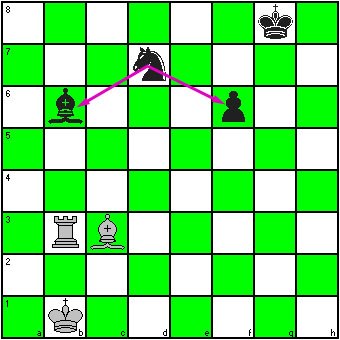
An overload occurs when a piece is trying to defend more then it can handle.
In this case, the knight is trying to defend two pieces. White can take advantage of this by taking one of the pieces. If white takes the pawn with his bishop, one of two things occur.
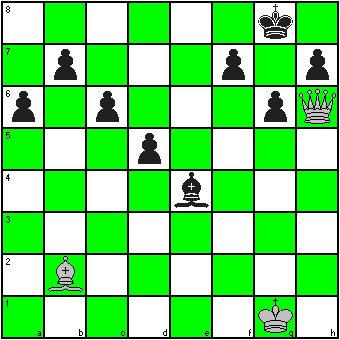
A colour complex occurs when a players pawns are weak on certain colour squares. (Especially if the opponent is strong on that colour)
Have trouble spotting forks until after it is too late? Ever wonder if there is a trick to help spot them?
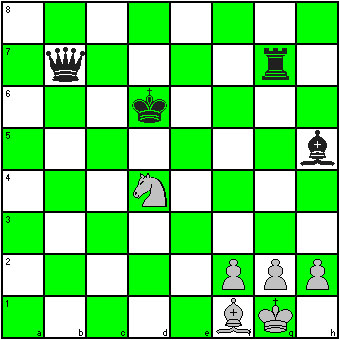
Something you must realize about pawns, knights, and bishops, is that they can only fork pieces that are on the SAME colour square. In this example, the king and the queen are on a different colour square. There is no way for them to be forked. Same is true for the bishop and rook. No need to look for forks between those pieces. The bishop and queen are on the same colour, this doesn't mean they can be forked, just that you have to check. The only way to fork them however is to get the white bishop to f3, it can't, so they are safe. The king and the rook are on the same colour square, they might be able to be forked. If you can get your knight to e8 or f5 a fork can occur. E8 is defended, and you can't reach it besides. Thus f5 is the fork.