When is a piece good?
Sometimes you might hear that a given piece is very good. How can you tell? What do they mean? Look at this example.
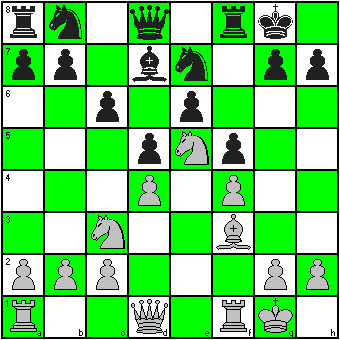
Lets look at the knight on e5. This piece is good. One of the simplest ways to tell, is to look at how many enemy squares and enemy pieces it attacks. In this example the knight attacks 4 enemy squares. (Half the knights total movement potential) Two of those squares are occupied, both of those pieces have to constantly worry about a knight trade. No pawns can be moved to chase the knight out. This knight is said to be in a good outpost square. (If a pawn can chase it out, it is a weak outpost square)
This knight is like a pair of aces in poker. You don't want to use it to beat a pair of two's. This knight should be left where it is until something worth its loss comes along. Sometimes this might even mean not trading it for a rook!!!Lets look at the same position again. This time pay attention to the d7 bishop.
This bishop is bad. In fact this bishop is sometimes referred to as "the bad bishop." First in general terms this bishop doesn't do anything. It doesn't attack any enemy squares, it doesn't protect any thing that needs protection, and it only has two possible squares it can go to. The bishop is not active, that is it isn't in whites face. The bishop is not passive, it doesn't defend anything. This bishop could be removed from the board right now and black might even be a bit better off. That is why the bishop is bad. But not why it is called the "bad bishop."
To be a "bad bishop," you need to be on the same colour square as most of your moved pawns. Especially the center pawns. In this case all of blacks moved pawns are on light squares. Thus blacks white square bishop is the "bad bishop." To add insult to injury, blacks bishop is INSIDE his pawns. Usually, your bad bishop is not as bad if it is outside of your pawns. Whites bishop, is the "good bishop." It is on a light square but whites pawns are on the dark squares.