- e4 e5
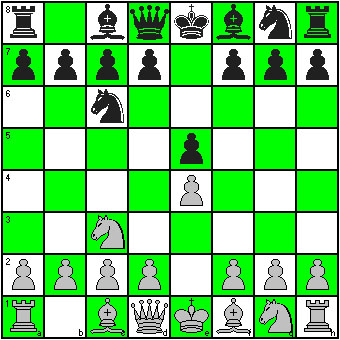
- Nc3 Nc6 -- So far this is an excellent example of a good opening. Watch now how even though both players have no real opening repertoire, white still gets his pieces out well ahead of black. This is because black wastes time advancing his knights instead of developing pieces.
After 2 ... Nc6
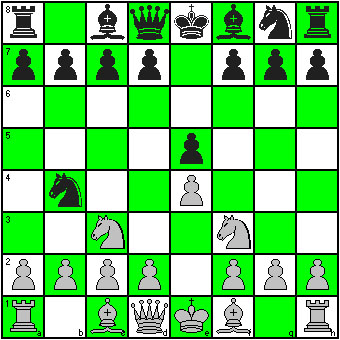
- Nf3 Nb4 -- This looks like an aggressive place for that knight, threatening c2+. This move is a total waste of time. It can be booted at any time and doesn't really threaten anything by itself. Black should be getting more pieces out instead
- Nxe5 -- A free pawn isn't always worth the lost move in the opening. It is often better to develop more pieces instead. Given blacks poor move however, there is no reason to think this kind of flirting with danger will not pay off against this player.
After 3 ... Nb4
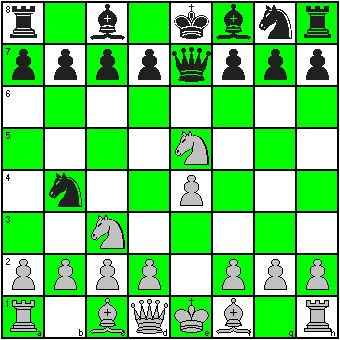
- ... Qe7 -- Very weak. d6 would have been better.
- d4 -- Blacks weak challenge of the knight allows white to develop as usual and not waste more time moving the knight yet a third time.
- ... f6 -- Finally kicked out, white will have to move the knight back. This move weakens a kingside castle, black might have been better off to kick the knight with the d7 pawn. Blacks g8 knight has its two best squares taken by black pieces.
- Nf3 d6 -- Black demonstrates a total lack of opening strategy. Black could have saved a turn and simply did this last move. (Two moves ago better yet) Then black would be a move ahead and have a stronger place for a kingside castle. This move betrays blacks "looking for something to do" mentality.
After 4 ... Qe7
- Be2 -- White opts for the safer placement of the light square bishop. Bc4 could have been met with d5. White wants to finish his development quickly. Even though Bd4 looks safe, it pins the e4 pawn and white doesn't want any complications until development is more or less completed. Especially since white is in the lead.
- ... Nh6 -- The only good square left for the knight. The problem is that the edge is not a good square. The weak attempt to kick out whites knight with the queen and then with the wrong pawn has come back to haunt black.
- O-O Ng4 -- Needlessly moving the same piece twice yet again. Now that white is finishing his development, he proves blacks knights are weak by forcing them back.
After 7. Be2
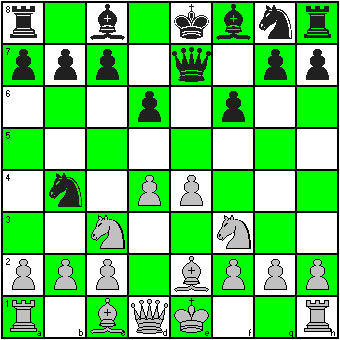
- h3 Nh6
- a3 Nc6
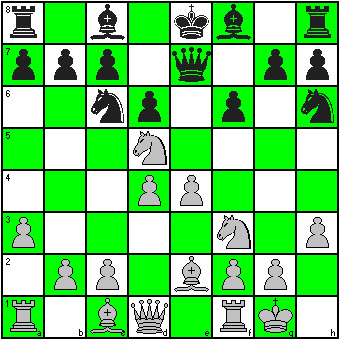
- Nd5 -- Now white decides to seize an outpost square with tempo. Black must move his queen, but he must be careful, if black leaves c7 unguarded the knight can take the pawn with check and then the a8 rook for free. If black takes the e4 pawn, not only is the a8 rook lost but very possibly the queen. Blacks king is right behind the queen and it can be pinned and won with whites rook. Though the rook pinning the queen looks far off, black should still worry.
After 11. Nd5
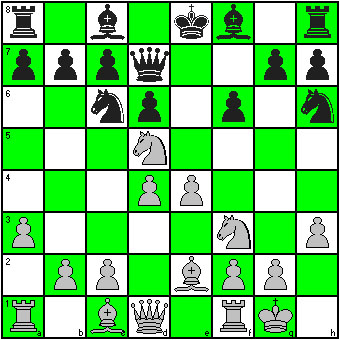
- ... Qd7 -- Black has conducted the opening poorly. Now that white has his pieces on good squares and his king nice and safe, tactical possibilities show up spontaneously. Here white attempts to remove the overloaded defender by decoying it away. The results are spectacular and the game is virtually won in the next few moves. Note that if black had pushed whites knight back with d6 way back at move 4, the black knight on h6 could have come to the better f6 square. This would have prevented this tactical opportunity from ever coming about. A mistake in the opening can haunt you for a long time. In this case it was move 4 that lost black the game by move 16.
- Bxh6 gxh6
- Nxf6+ Ke7
After 11 ... Qd7
- Nxd7 Bxd7 -- No more castling for black. No kingside pawns worth mentioning, and a loose king. Does he really need to also be behind 8 pawns worth of material?
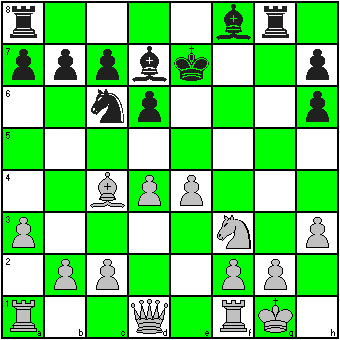
- Bc4 -- Moving the bishop to a more aggressive square. White has re-evaluated the bishops placement. The bishop looks much better on d4 because it attacks many more squares on blacks side, and black will be hard pressed to push it back. Note that with whites material advantage white will not hesitate to make even trades.
After 14 ... Bxd7
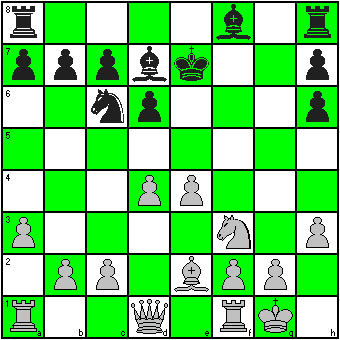
- ... Rg8 -- Thoroughly rattled, black makes a simple blunder. His resignation is soon to follow. Black was thinking (correctly) that he needs to win quickly because he is to far behind to survive for any length of time. Desperately searching for a quick win, black was thinking something along the lines of Bxh3. The pawn cannot take the bishop because it is pinned to the king. Black would then follow up with Rxg2+. He was hopping to be able to find a quick mate. His bad f8 bishop renders this plan hopeless, as there is no way for the a8 rook to come to the aid. Even if it could, there is no real mate to be had in this plan. All this is discussion is rendered academic by the good placement of whites c4 bishop anyway
- Bxg8 -- Black resigns. We don't know how good a player black is; all we really know is that he is week with his openings. This proves that if your opening doesn't even have basic guidelines, you will not live long enough to prove skill in the middle game.
After 15 ... Rg8