One thing to realize is that how you open effects what kind of
middle game plans you have to choose from. This fact lets you direct the style
of game to one you want.
Lets take this typical opening. Both players follow basic opening
plans. One players actions prompts a change in the others move
order. White initially follows the same basic plan I introduced earlier.
- e4 g5 <- prepares Bg6
- d4 Bg6
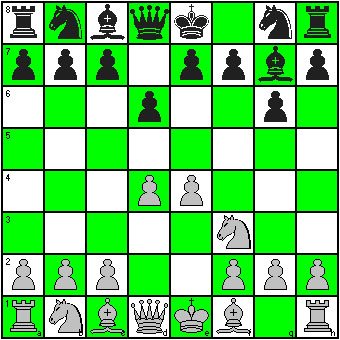
- Nf3 d6 <- black wants to move his knight out to f6 but is afraid
of e5. So d6 first to try to talk white out of it.
|
After 3 ... d6
 |
- Nc3 Nf6
- Bc4 0-0
- Be3 <- White has noted blacks castle to kingside. Whites plan is
to now castle to queenside to allow a kingside pawn storm. Whites last
move prepares this while at the same time doing nothing out of the
ordinary. Black will not know yet what whites plan is.
White is careful not to start pushing his pawns yet. If blacks
actions force white to castle kingside, then white needs a strong
kingside pawn formation.
|
After 5 ... 0-0 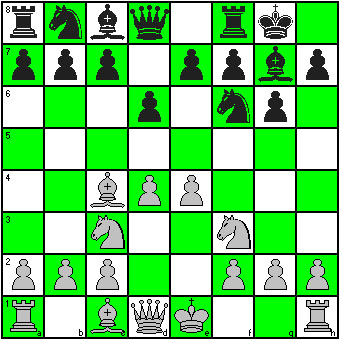 |
- ... Bg4 <- Black continues the development
- Qe3 Nc6
- 0-0-0 <- Both sides have completed their development. White
has prepared for a kingside pawn storm. Black will either
counterattack in the center or start a queen side pawn storm.
Given that white has a superior center blacks first choice is
counterattack in the center. One trade off white has made is that
in taking the extra time to prepare the attack, white has left black
with the first non-opening move. It is blacks turn and he will
want to start his attack now in the hopes of pre-empting whites
attack.
|
After 8. 0-0-0 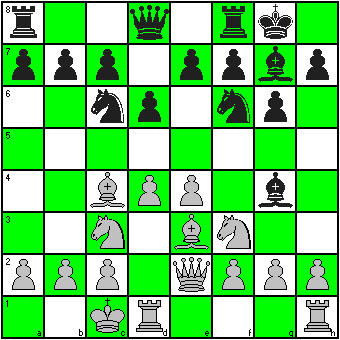 |