What are you talking about when you say 1. e4?
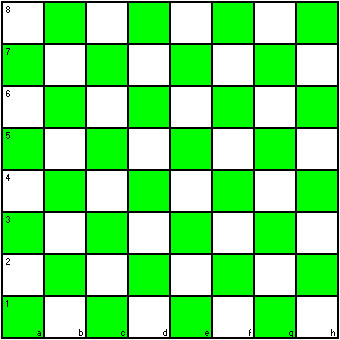
This is the general standard that you will see a chess game written in. This is the style that I use in my own page. First lets look at the board.
Notice the letters along the bottom. Those are the names of the vertical rows, commonly referred to as files. The file on the far left is the A file and the file on the far right is the H file.
The numbers along the left side of the board are the names of the horizontal rows. These rows are commonly referred to as ranks.
A square is name for the file and rank it is a part of. Thus the square in the lower left is a1. The square in the top right is h8. The squares d4, d5, e4, e5, make up the center.
A move is made by the letter of the piece and its destination square. Thus a king to e2 is written Ke2. Notice that the letter for the piece is a capitol and the letter for the square is small. Pawns don't have a letter, they are written with just the destination square. The move e4, is pawn to e4. The letters for the pieces are
When a piece captures another the letter x is added between the piece letter and the destination square. Thus queen takes e4 is written Qxe4. If a pawn takes a piece, the source file is written. If a pawn on d3 takes e4, it is written dxe4.
If a move ends in check, you add a + to the end of the move. Thus Qe4+, is queen to e4 check.
If a move ends in mate, you add either a ++ or a # to the end. Thus Bg3++, is bishop to g3 mate.
If more then one piece of the same type can move to a square, you have to specify a source file or rank. Thus if two knights can get to e4, you write Nde4. That is knight on d to e4. If both knights are on the d file then it would be N2e4, knight on 2nd rank to e4. With a capture it is N2xe4, knight on 2nd rank takes e4.
If a pawn promotes you add either the letter of the piece you promote to, or = and the letter. Like so, e8=Q, pawn to e8 becomes a queen. Perhaps something like e8N, pawn to e8 becomes a knight. Could even be something like, dxe8R++, pawn takes e8 becomes a rook, checkmate.
Castling and En-Passant are special moves. Castling kingside (short castle) is written 0-0. Castling Queenside (long castle) is written 0-0-0. En-Passant is written the exact same as a regular pawn capture. Sometimes the additional EP is added to the end but it isn't required. That would look like exd6ep.
Finally you can add a mark to then very end of a move to show if it is a good move or not. The marks are
Thus Qd8??, marks this move as a bad mistake, probably lost his queen or the game. You can also get something like e8Q?, in this case promoting the pawn to a queen was a mistake, perhaps a knight would have done better or maybe you should have moved something else.
So now you can read each individual piece move, but was it whites move?? You write down who's move it is as well as in what order like so
The first section is whites move and the second section is blacks move. This move order is the Classical Sicilian Defence. If you need to pick up in the middle of the game somewhere with an unknown move number, you just start at 1. If you need to start with blacks move you need to start with ... This looks like
This style is often used where you think most chess players are beginners. This style is found, for example, at Yahoo Games where many players don't know how to read chess notation.
Notice the letters along the bottom. Those are the names of the vertical rows, commonly referred to as files. The file on the far left is the A file and the file on the far right is the H file.
The numbers along the left side of the board are the names of the horizontal rows. These rows are commonly referred to as ranks.
A square is name for the file and rank it is a part of. Thus the square in the lower left is a1. The square in the top right is h8. The squares d4, d5, e4, e5, make up the center.
A move is written by writing the source and then the destination square. For example pushing the pawn in front of your king up two squares is written e2-e4. Sometimes the piece that is moved is shown by adding the letter for that piece to the beginning. Qd1-h5, is queen from d1 to h5. Notice that the letter for the piece is a capitol and the letter for the square is small. Pawns don't have a letter, they are written with just the source and destination squares. The letters for the pieces are
When a piece captures another the letter x is added between the source square and the destination square. Thus queen on d1 takes e4 is written Qd1xe4. A pawn capture would be something like e4xd5.
If a move ends in check, you add a + to the end of the move. Thus Qd1-e4+, is queen from d1 to e4 check.
If a move ends in mate, you add either a ++ or a # to the end. Thus Bf1-g3++, is bishop from f1 to g3 mate.
If a pawn promotes you add either the letter of the piece you promote to, or = and the letter. Like so, e7-e8=Q, pawn to e8 becomes a queen. Perhaps something like e7-e8N, pawn from e7 to e8 becomes a knight. Could even be something like, d7xe8R++, pawn from d7 takes e8 becomes a rook, checkmate.
Castling and En-Passant are special moves. Castling kingside (short castle) is written 0-0. Castling Queenside (long castle) is written 0-0-0. En-Passant is written the exact same as a regular pawn capture. Sometimes the additional EP is added to the end but it isn't required. That would look like e5xd6ep.
Finally you can add a mark to then very end of a move to show if it is a good move or not. The marks are
Thus Qd1-d8??, marks this move as a bad mistake, probably he lost his queen or the game. You can also get something like e7-e8Q?, in this case promoting the pawn to a queen was a mistake, perhaps a knight would have done better, or maybe you should have moved something else.
So now you can read each individual piece move, but was it whites move?? You write down who's move it is as well as in what order like so
The first section is whites move and the second section is blacks move. This move order is the Classical Sicilian Defence. If you need to pick up in the middle of the game somewhere with an unknown move number, you just start at 1. If you need to start with blacks move you need to start with ... This looks like
Descriptive notation is the old style. Not commonly used anymore, this style is still good to know.

In this style the vertical rows, commonly referred to as files, are named by the piece. Starting from left to right the files are named
Notice that the names are the same for blacks side.
The horizontal rows, commonly referred to as ranks, are numbered. The bottom rank is the 1st. Ranks are named respectively from the side they are referring to. Thus blacks 1st rank is whites 8th.
A square is named after its file and rank. Thus the square in the bottom left (a1) is queens rook 1 for white or queens rook 8 for black. For white the center squares are queen 4, queen 5, king 4, king 5. This is the same for black except that queen 4 is closer to blacks side of the board then queen 5.
A move is made by the piece and the name of the square it moves to. The pushing the queen up two squares is from the starting square referred to as: queen to queen 3. This is written Q-Q3. The letter for the pieces are
When a piece captures another, the piece and the piece taken are written with an x in the middle. QxQ is queen takes queen. PxP is pawn takes pawn. NxR is knight takes rook.
If a move ends in check, you add a + to the end of the move. Thus Q-K4+, is queen to king 4 check. Sometimes they add the letters ch to the end. B-N3ch is bishop to knight 3 check.
If a move ends in mate, you add either a ++ or a # to the end. Thus B-KN3++, is bishop to kings knight 3 mate. Sometimes they just say mate or checkmate. Q-N7 mate is queen to knight 7 mate.
If more then one piece of the same type can move to a square, you have to specify the source. If it is early in the game and the piece can still be easily identified as being king side or queen side you can specify like so QNxK4 or queens knight takes king 4. If the source of the piece is no longer obvious, you specify the start square like so N(Q2)xK4 or knight on queen 2 takes king 4.
Often times the information is abbreviated. For example if only one knight can make it to a bishop 3 square, there is no need to say if it is a kings bishop or queens bishop square. In general you should specify until you have gotten used to writing this style of notation.
If a pawn promotes you add = and the letter of the piece you promote to. Like so, P-K8=Q, pawn to king 8 becomes a queen. Perhaps something like P-K8=N, pawn to king 8 becomes a knight. Could even be something like, PxQ=R++, pawn takes queen becomes a rook, checkmate.
Castling and En-Passant are special moves. Castling kingside (short castle) is written 0-0. Castling Queenside (long castle) is written 0-0-0. En-Passant is written PxPep
Finally you can add a mark to then very end of a move to show if it is a good move or not. The marks are
Thus Q-Q8??, marks this move as a bad mistake, probably lost his queen or the game. You can also get something like P-K8=Q?, in this case promoting the pawn to a queen was a mistake, perhaps a knight would have done better or maybe you should have moved something else.
So now you can read each individual piece move, but was it whites move?? You write down who's move it is as well as in what order like so
The first section is whites move and the second section is blacks move. This move order is the Classical Sicilian Defence. If you need to pick up in the middle of the game somewhere with an unknown move number, you just start at 1. If you need to start with blacks move you need to start with ... This looks like